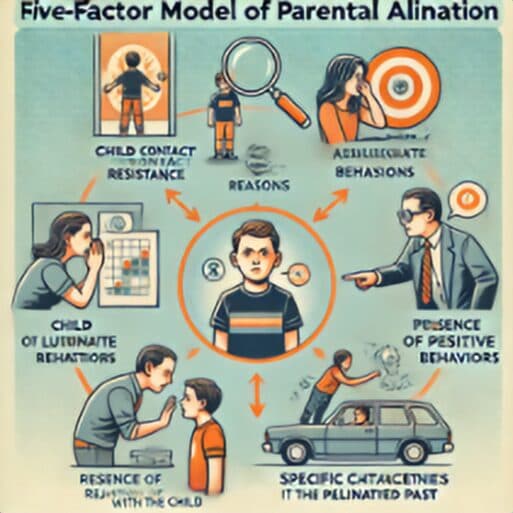
How do you know it is parental alienation?
In a case where a child rejects contact with a parent, an evaluator can determine if the rejection is unwarranted, which is called parental alienation, by making a thorough investigation of the empirical facts over time. If the child has a legitimate reason to reject a parent, it is called estrangement.
An evaluator can use the Five-Factor Model to identify and diagnose parental alienation. If the answer, after thorough and qualified investigation, to all five questions below is yes, it is most probably a case of severe parental alienation.
- Does the child refuse contact?
- Did the child before refusal of contact have a loving relationship with the now rejected parent?
- Is there a lack of confirmed, reliable information about abuse or neglect from that parent?
- Is there documentation over time that the other parent has used several of the 17 identified alienation strategies?
- Does the child manifest the 8 characteristics for an alienated child?
Sources
[practitioner guidance] Lorandos, D., Bernet, W. (2020). Parental Alienation — Science and Law.
[practitioner guidance] Baker, A. J. L., Schneiderman, M. (2015). Bonded to the Abuser.
[peer-reviewed study] Roseby, V., Johnston, J. R. (1998). Children of Armageddon: Common Developmental Threats in High-Conflict Divorcing Families. Child and Adolescent Psychiatric Clinics of North America, 7(2):295–309.
Go deeper: how to tell the difference →
Parental alienation is not a medical or psychiatric diagnosis. What is recognised is that some parents behave in ways that damage a child’s relationship with their other parent, and that this can seriously harm children — and equally, that a child may refuse contact for good reasons, including abuse. Nothing here is a diagnosis or legal advice. What this site does and doesn’t claim.